A Good King Blade Sharpener & Why You Need It in Your Kitchen
In a busy kitchen, you can’t afford working with dull blades. Electric knife sharpeners are life-changing for anyone who cooks. Within seconds, you can enjoy that sharp new edge your knives require — none of this requires special skills or training.
It’s a faster, safer time in the kitchen with knives. The duller your blade, the more pressure you have to apply — and the higher your likelihood of slipping and cutting yourself. Knives like these will slide through a tomato, cut meat cleanly and make prep work feel easy.
Learning to use more traditional sharpeners, like whetstones, can be complex and time consuming. And who wants to spend 20 minutes sharpening just one knife? That’s where the electric knife sharpener comes in. They do the hard work so you don’t have to, and they use motorized abrasive wheels or belts that can quickly restore your blade’s edge with professional-like precision each time.
Other Features That Set These Sharpeners Apart
Before we get to our recommendations, though, let’s discuss the difference between a great electric knife sharpener and one that’s just okay.
Speed and Convenience
The best models will sharpen an entirely dull knife to a quite sharp edge in less than a minute. Some can restore a slightly dingy blade in as little as 10-15 seconds. This matters when you’re in the middle of meal prep and a chef’s knife isn’t chopping as well as you know it should.
Multiple Sharpening Stages
Good sharpeners typically have 2-3 stages. The initial stage helps remove damaged metal and reprofile the edge. The second step sharpens the edge. A third polishing stage is available on some models for a smoother, shaving-sharp finish.
Versatility Across Blade Types
The best electric knife sharpeners are compatible with various blade types. Virtually all of them handle normal kitchen knives just fine. Some are able to sharpen serrated blades as well as pocket knives and even scissors.
Safety Features
Good sharpeners come with non-slip feet, blade guides to help position your knife at its correct angle and magnetic holders that prevent metal shavings from scattering across your counter.
Here are Our Top 7 Picks for Quick and Easy Sharpeners
Here, the seven best electric knife sharpeners that busy kitchens rely on. Each has something great to recommend it, whether speed, precision or bang for your buck.
Chef’sChoice Trizor XV EdgeSelect
This professional sharpener is our favorite for a reason. It uses diamond abrasives in all three stages to form a triple beveled, 15-degree edge that rivals factory quality. The Trizor XV accommodates both straight and serrated blades.
The machine adjusts the angle at which your knife is held perfectly for you. You just drag the blade through each slot a couple of times. In 45 seconds or less, even the dullest knife emerges sharp enough to slice paper.
• Diamond abrasive technology
• Works with serrated knives
• Creates a 15-degree edge angle
Work Sharp Culinary E5
Get excited about innovation, flexibility and the way to a sharp knife’s edge – instead of carrying on with dull and damaged blades. The new Work Sharp E5 electric kitchen knife sharpener is the easy, quick-to-sharp (and even stylish) way to keep all your knives razor sharp. You can also use it for serrated knives! This system takes off less metal from your blades, meaning your knives last longer.
It has guides for both 15-degree and 20-degree angles, so you can select the right edge for your knives. The E5 also features a dedicated scissor sharpener attachment and stropping belt to hook onto the machine for that final polished edge.
• Adjustable angle guides
• Scissors sharpening attachment
• Built-in stropping function
Presto EverSharp
If you need a good, basic machine that does not cost you an arm and a leg, the Presto EverSharp ought to be on your shortlist. This 2-stage sharpener utilizes precision blade guides and Sapphirite sharpening wheels.
One of the easiest electric knife sharpeners to use. Just plug it in and turn it on and pull your knife through the slots. Its compact size doesn’t consume counter space that may be at a premium in smaller kitchens.
• Sapphirite abrasive wheels
• Compact footprint
• Very affordable price point
KitchenIQ Edge Grip
The KitchenIQ Edge Grip is the best of both worlds, an electric-driven sharpener with manual-control. It has a patented two-stage system that boasts motorized sharpening wheels and a nonslip base, which actually suctions to your counter.
And it’s the portability that sets this model apart. It’s also smaller and lighter than most electric knife sharpeners, so you can easily stow it away or carry it to a vacation rental. Even though it’s compact, it packs a punch when sharpening.
• Lightweight design
• Two-stage system
• Easy to store and transport
Chef’sChoice Diamond Hone Model 120
Yet another Chef’sChoice model earns a spot on our list for its fantastic three-stage system. The Model 120 has a precision guide that will provide your knife with a professional edge and is easy to use and very safe. This equates to faster sharpening and longer abrasive life.
The machine produces a 20-degree edge angle, which is perfect for most Western-style kitchen knives. It handles everything from paring knives to big chef’s knives comfortably.
• 20-degree edge angle
• Magnetic holding for metal shavings
• Durable construction
Smith’s EdgeWare 50085
The Smith’s 50085 provides a two-step sharpening in an entry-level model. Do not be deceived by the price point — this sharpener does a bang-up job on all your day-to-day kitchen needs.
With easy pull-through slots, it is easy to use. It has a small size to fit easily in any drawer. It won’t give you the same mirror-polished edge of a more expensive model, but it will change how you maintain your knives — for our money, it’s the only option that will actually keep them sharp.
• Budget-friendly
• Drawer-friendly size
• Simple operation
Brod & Taylor Professional Knife Sharpener
The Brod & Taylor sharpener features the only spring-action system that flexes to compensate for your knife’s factory-set existing edge angle. That makes it highly versatile — you can use it with Asian knives, European knives and everything in between.
The 3-stage process sharpens, then hones, and finishes in a separate compartment for a smooth polished edge. The two stages have a visual and audio signal to show when your knife is ready by either showing potential cuts or triggering vibration in the blade.
• Three-stage progression
• Audio and visual indicators
• Works with varied blade angles
Comparing the Top Models
| Model | Stages | Edge Angle | Serrated Blade Capability | Special Features | Price Range |
|---|---|---|---|---|---|
| Chef’sChoice Trizor XV | 3 | 15° | Yes | Diamond abrasives | $$$ |
| Work Sharp E5 | 3 | 15°/20° | Yes | Belt system, scissors attachment | $$$ |
| Presto EverSharp | 2 | 20° | No | Affordable, compact | $ |
| KitchenIQ Edge Grip | 2 | 20° | No | Suction base, portable | $$ |
| Chef’sChoice Model 120 | 3 | 20° | No | Diamond abrasives | $$$ |
| Smith’s EdgeWare 50085 | 2 | 20° | No | Ultra-compact, affordable | $ |
| Brod & Taylor Professional | 3 | Variable | No | Spring-action guides | $$ |
Prices: $ = Below $50, $$ = $50 to $100, $$$ = More than $100
Choosing the Proper Sharpening Solution for You
The most expensive sharpener isn’t necessary for every kitchen. Take these factors into consideration when choosing.
How Often You Cook
If you’re cooking three meals a day, it’s probably worth investing in a good sharpener. You’re going to use it enough that the investment will be worth it. Meanwhile, weekend cooks will be satisfied with a budget model.
Your Knife Collection
If you own a lot of pricey, Japanese-made knives, you might be more interested in a sharpener that lets you choose from several angles. If your primary knives are plain-vanilla grocery store models, a basic two-stage sharpener will do wonders. For more information about professional sharpening techniques, visit DTDF Knife Sharpening for expert guidance.
Available Counter Space
A number of electric knife sharpeners just take up more space than we’d prefer. Be certain you have space to store it, or opt for a compact version that slips into a drawer.
Your Budget
Sharpeners can cost anywhere from $30 to more than $200. The silver lining is that, even on the most affordable of them, you can get decent results. You don’t have to break the bank in order to keep your knives sharp.
How to Get the Most Out of Your Sharpener
The best electric knife sharpeners won’t serve you well if you don’t know how to use them. Use these tips for best results.
Clean Your Blades First
Wipe your knives down before sharpening. Food residue or grease should not be allowed to accumulate and gum up the sharpening wheels, hampering performance.
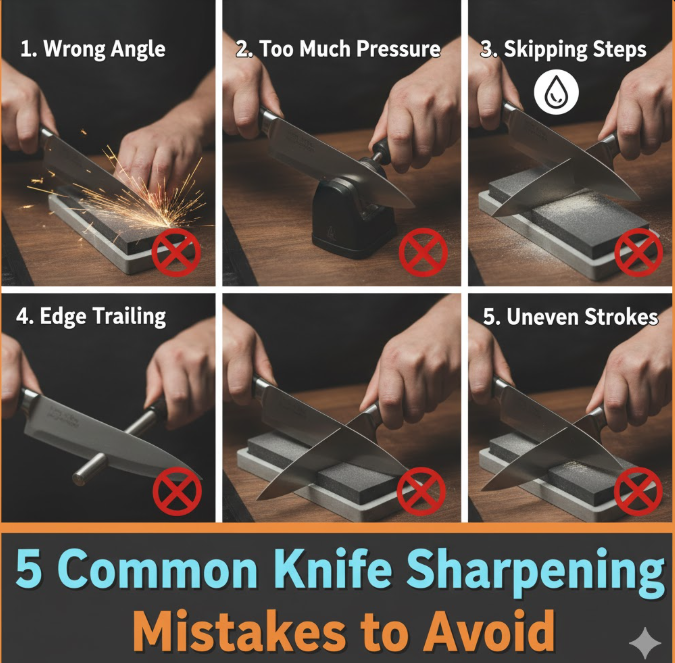
Use Light Pressure
Let the machine do the work. Don’t bear down too hard on your knife as you pull it through the slots. The best is light, even pressure.
Go Through All Stages
Never cut corners. There is never time to not follow the stages properly. Each stage serves a purpose. Coarse stage removes damage, medium stage refines and fine stage polishes. When you skip stages your edge will be less smooth and it will not last as long.
Sharpen Before Knives are too Dull
You don’t want to be holding your knife and realize it can no longer cut a tomato. Maintain your blades when you first start to notice that they’re getting dull. This is faster and removes less metal from your knives.
Clean the Sharpener Regularly
Metal particles accumulate in the sharpening chamber. Many of them come apart for cleaning. A rapid brush-out every couple of uses, and it’s back like new. For additional maintenance tips, check out The Spruce Eats for comprehensive kitchen tool care guides.
Common Mistakes to Skip
These are the mistakes that people make when they use electric sharpeners for their knives. Stay away and keep better care of your knives for better results.
Sharpening Too Often
More sharpening isn’t always better. Over-sharpening will take off more metal than needs to be taken and hence reduce the life of your knife. Most kitchen knives require sharpening every 2-4 weeks with normal use.
Employing the Incorrect Serrate Slot
Use the special slot for serrated blades if your sharpener has one. Running serrated blades through standard slots ruins the teeth.
Rushing Through the Process
Draw through the sharpening slot in one smooth motion. Rushing creates an uneven edge.
Ignoring Safety Features
There must be a reason for that blade guide. They maintain the correct angle for your knife and keep your fingers safe. Don’t try to bypass them.
Signs Your Knives Need Attention
Not sure when to sharpen? Watch for these warning signs.
- Your knife mashes, rather than neatly slices, tomatoes.
- That doesn’t help you at all when it comes to cutting through meat.
- The blade glides over, rather than digs into, vegetable skins.
- For basic cutting, you really have to push down a bit.
When you start to see any of these signs it is time to take out your knives and run them through an electric sharpener. Don’t let your blades be completely worthless before you replace them. It is easy and safe to cut, thanks to regular maintenance.
Frequently Asked Questions
Making Your Final Decision
The best electric knife sharpener for you depends on your kitchen’s needs. Professional cooks who are chopping all day long will relish the accuracy of Chef’sChoice Trizor XV or E5 from Work Sharp. While they’re pricier, these models are all super reliable.
For home cooks with standard knife collections and regular cooking routines, we like the Presto EverSharp or KitchenIQ Edge Grip. These are mid-range options that balance quality with affordability.
On a budget or if you only cook every once in a while, you can’t really mess up the decision to go with the Smith’s 50085. It keeps your knives working without breaking the bank.
Whichever model you get, you’ll be left wondering how you ever lived without one. When you have sharp knives, cooking is more fun, safer and faster. That’s worth every penny.